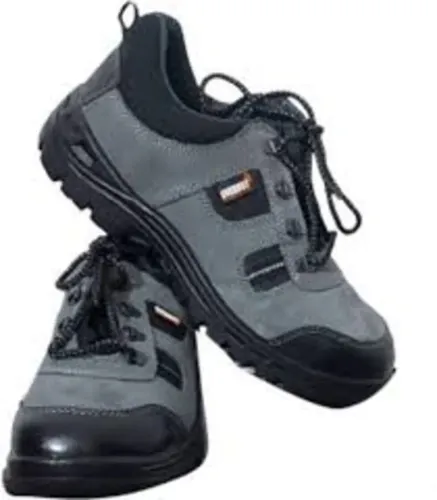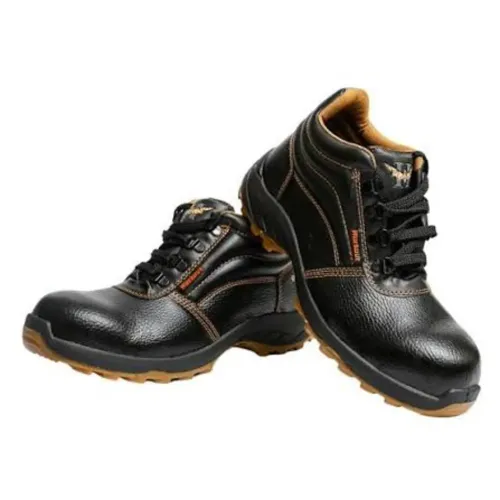
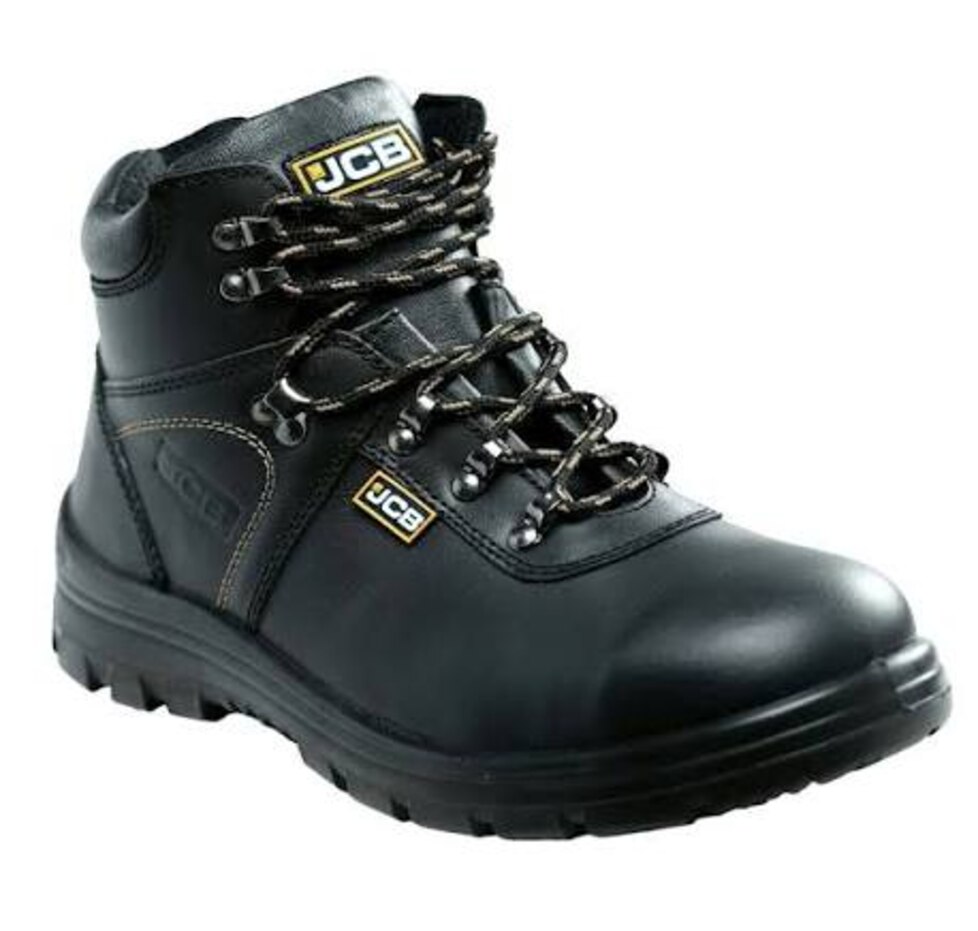
A JCB label does not tell you whether a shoe can withstand falling objects, sharp debris, standing water, hot surfaces, chemicals or electrical contact. By checking the individual model’s markings, certification, construction and fit against the hazards at your site, you can decide when the footwear is suitable—and when a different protective system is required.
Key takeaways
- Check the model’s EN ISO 20345 or IS 15298 certification before relying on its label.
- Use S2, S3 and penetration markings to compare protection against site hazards.
- Match the upper and outsole to water, oil, heat and chemical exposure.
- Test toe clearance, grip and compatibility with your actual worksite conditions.
Start with the shoe’s certification, not the JCB label
A JCB safety shoes label does not establish suitability; the individual model’s certification does. Treat the footwear as industrial safety footwear only after checking its marking, declaration of conformity, user instructions and certificate against EN ISO 20345 or IS 15298.
The words “safety shoe” alone reveal nothing about penetration, water resistance, slip performance or toe-cap material.
Check the model and paperwork for these points:
- Confirm the exact model code on the shoe, box and declaration. Do not approve a range name when different models carry different protections.
- Read the complete classification and symbols. Under EN ISO 20345:2021, S3 combines S2 properties with a cleated outsole and penetration resistance, making it relevant to rough construction and site work.
- Match the marking to the hazard. An S-class does not prove chemical resistance, electrical protection, metatarsal protection or chainsaw cut resistance.
- Remember the limit of ordinary toe protection: the standard test uses 200 joules of impact and 15 kilonewtons of compression. Falling machinery, sharp edges and severe crushing can require a different protective system.
For IS 15298 safety shoesus, verify the actual Indian-standard marking and certificate rather than relying on a search result or brand claim. Then test the selected pair with required socks: heel lift, cramped width, internal movement and poor grip can make a correctly certified shoe unsafe for the task.
A warehouse model is not automatically suitable for a foundry, chemical plant or energized electrical work.
Use S2, S3 and penetration markings to match everyday site hazards
For construction, warehouses and general industrial work, choose the marking that matches the hazard, not the shoe’s claimed toughness. S2 safety shoes add water penetration and absorption resistance to S1 properties, which suits indoor handling and ordinary wet conditions.
S3 safety shoes add cleated outsoles and penetration resistance, making them more relevant where rubble, nails or uneven ground are present.
| Marking | What it means | Where it fits |
|---|---|---|
| S2 | S1 protection plus water penetration and absorption resistance in the upper | Warehouses, covered loading areas and general industrial floors |
| S3 | S2 properties plus a cleated outsole and penetration resistance | Construction sites, rough ground and debris-prone work areas |
| P, PL or PS | Penetration resistance: metallic insert, or non-metallic insert tested with different nail types | Sites where nails, screws, scrap or sharp fragments threaten the sole |
| WR | Whole-footwear water resistance | Standing water, persistent rain and wet processing areas |
S2 and S3 do not mean the entire shoe is waterproof; look for WR when water surrounds the footwear. The penetration marking also needs checking: P, PL and PS describe different test arrangements, so confirm which one the model carries.
Toe protection has defined limits: toe cap impact is 200 joules and toe cap compression pressure is 15 kN. That protects against the standard test loads, not every falling machine part or crushing event.
The S-class alone also provides no chemical, electrical, metatarsal or chainsaw protection; match those hazards to separate markings and the model’s certification.
Match the upper and outsole to water, oil, heat and chemical exposure
A shoe’s upper protects the foot from the surrounding environment; its outsole deals with the surface beneath it. Compare both separately, because a water-resistant safety shoe with a suitable upper can still fail when its outsole softens in oil or loses grip on a contaminated floor.
| Material | Strength | Limitation and suitable use |
|---|---|---|
| Leather | Durable, breathable and comfortable for dry industrial work; treatments improve water resistance | Absorbs water, oils and chemicals unless specifically treated; check the WR marking for whole-footwear water resistance |
| PU | Lightweight, flexible and resistant to water; useful for warehouses and general wet work | Chemical and heat performance depends on the formulation; do not assume resistance to solvents or hot surfaces |
| PVC | Impermeable and practical for standing water, mud and some wet-processing areas | Less breathable; stiffness, cracking and chemical resistance vary by compound and temperature |
| Rubber | Strong wet grip and useful resistance to selected oils, chemicals and heat | Performance differs by rubber type; verify the exact chemical and temperature limits |
FO fuel oil resistance addresses the applicable fuel-oil test, not solvents, acids, caustics or process chemicals. Obtain a compatibility chart for each substance, concentration, temperature and contact time before approval.
For heated floors or hot materials, HRO outsole heat resistance covers hot contact, not continuous heat or molten-metal splash. Check heat insulation, contact duration, upper, stitching and fasteners separately. S2 or S3 water-related properties concern upper penetration and absorption; choose WR footwear for prolonged rain, standing water or persistent wet processing.
Know when standard toe protection is not enough
A general-purpose EN ISO 20345 safety shoe becomes unsuitable when the job demands protection beyond toe impact, compression, ordinary slip resistance or penetration resistance. The S-classification does not prove electrical insulation, foundry heat protection, chemical compatibility, chainsaw cut resistance or whole-foot crush protection.
Choose a different specification when the work involves:
- Live electrical conductors: antistatic footwear dissipates static charge; it does not insulate you from electricity. Select electrical hazard footwear or dielectric safety shoes with the required electrical test marking, and follow the electrical-work procedure.
- Molten metal or foundry heat: look for footwear tested for heat insulation and molten-metal splash resistance. A standard leather upper and ordinary outsole can fail when hot material enters through the opening or bonds to the sole.
- Solvents, acids, caustics or process chemicals: FO means fuel-oil resistance under a footwear test, not resistance to chemicals generally. Check compatibility with the exact substance, concentration, temperature and exposure time.
- Chainsaw operation: use chainsaw protective footwear with a specified cut-resistance class. A steel or composite toe cap does not stop a moving chain.
- Falling machinery, very heavy loads or crushing between objects: confirm whether metatarsal protection, reinforced side protection or another protective system is required.
A toe cap is tested for 200-joule impact and 15-kilonewton compression, but it covers only the toes. Treat those figures as limits, not proof that the entire foot can withstand a severe crush.
Verify the model, then test fit and site compatibility
Approve a JCB model only after confirming its individual markings, documents, fit and work-area hazards. The JCB label and the words “safety shoe” do not establish protection.
1. Record the safety shoe model marking printed on the tongue, packaging and product literature. Match it with the declaration of conformity, user instructions and certification for EN ISO 20345:2021 or the standard named in the documents.
Confirm the toe type, S-class, slip-resistant outsole and P, PL or PS penetration resistance marking; do not accept a supplier’s generic catalogue description.
2. Check site-specific claims before approval. S3 does not make footwear suitable for every heavy-industry task. Look for WR for prolonged wet work, FO only for tested fuel-oil resistance, and HRO for hot outsole contact.
Foundries, chemical plants, energized electrical work, chainsaw operations and explosive atmospheres require separate checks for heat insulation, molten-metal splash, chemical compatibility, dielectric protection, cut resistance or electrostatic control.
3. Test the actual size with the worker’s normal socks. Require toe clearance without heel slip, secure fastening, comfortable width and stable walking on stairs, ramps, ladders and uneven ground.
Ask Shree Krishna Safety Products to document this model-to-hazard match when comparing footwear options; a specification sheet that omits the marking or certificate is not approval evidence. Reject the pair if its markings, documents and physical construction do not agree.
Frequently asked questions
What should you check before buying JCB safety shoes?
Check the individual model’s marking, declaration of conformity, user instructions and certificate against EN ISO 20345 or IS 15298.
What do S2 and S3 safety shoe ratings indicate?
S2 includes a protective toe cap, closed heel area, antistatic properties, energy absorption and water resistance of the upper. S3 adds cleated outsoles and penetration resistance.
When is standard toe protection not enough?
Use additional protection when your work involves falling heavy objects, sharp materials, electrical hazards, extreme heat or chemicals beyond the shoe’s stated rating.
How can you verify a safety shoe’s site compatibility?
Confirm the exact model and markings, then test fit, grip, toe clearance and outsole performance against the surfaces, liquids and temperatures at your site.