A sharp object does not automatically require the same glove: a paper edge, a sheet-metal burr and an exposed rotating blade create different risks. By the end, you will be able to identify the actual hazard, compare EN 388 and ANSI/ISEA 105 ratings, and specify a glove that protects without creating new problems.
Key takeaways
- Use cut-resistant gloves for blades, burrs, glass, wire and broken components.
- Match the glove rating to edge sharpness, force, grip and work conditions.
- Check EN 388 and ANSI/ISEA 105 scores instead of relying on marketing terms.
- Replace gloves when cuts, thinning, loose fibres or reduced grip appear.
Identify the tasks that expose hands to cuts
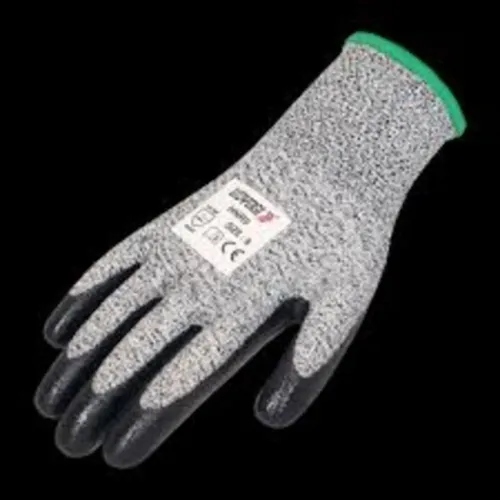
Use cut-resistant hand gloves when your hand could contact a sharp edge during cutting, deburring, fabrication, assembly, recycling, warehouse handling or maintenance. Typical examples include knife edges, sheet-metal burrs, glass, sharp plastics, stamped parts, wire, exposed blades and broken components.
Gloves are justified when moving stock by hand, trimming material, opening packaging, clearing scrap or servicing equipment after isolation when the residual edge hazard remains.
- Treat the task as a laceration hazard when contact with an edge could slice skin through sliding, pulling or forceful handling.
- Do not use gloves to justify placing a hand near an unguarded moving blade, rotating shaft or other entanglement point. Apply guarding, isolation, fixtures or mechanical handling first; the machine-specific assessment decides whether gloves are permitted.
- Choose glass handling gloves for glass work only after checking whether the task also involves puncture, grip loss, sharp fragments or breakage.
| Hazard | Exposure clue | Protection implication |
|---|---|---|
| Laceration | Sliding contact with an edge or blade | Cut resistance addresses the slicing risk |
| Puncture | A point, spike, wire end or shard presses through | Check puncture resistance; cut resistance alone is insufficient |
| Crush or impact | Fingers enter a pinch, strike or drop zone | Use machine controls and impact or crush protection |
| Abrasion | Repeated rubbing wears the glove or skin | Check abrasion resistance and inspect wear |
| Heat, chemical or electrical | Hot surfaces, liquids or energised parts contact the hand | Select separate heat, chemical or electrical protection |
A high cut rating does not control every injury. Match protection to the actual material, force, motion and foreseeable failure, while preserving enough dexterity and grip for workers to keep the gloves on.
Match the glove to the edge, force and working conditions
Assess the actual contact, not just the material’s name. Examine edge sharpness, burrs, serrations, blade exposure, contact force, cutting speed and whether the hand pushes, pulls, presses or twists. A slow slide against a dull edge differs from a fast, forceful draw cut.
| Material or task | What to assess | Selection implication |
|---|---|---|
| Sheet metal, stamped parts | Burr direction, exposed corners, force needed to lift or stack parts | Choose protection for repeated edge contact; check dexterity for alignment work |
| Sharp plastics and glass | Edge thickness, breakage, fragments and handling speed | Match cut protection with grip and puncture protection if fragments can penetrate |
| Wire handling | Wire gauge, cut ends, spring-back and pulling force | Choose a glove that resists the wire’s point and remains secure during tension |
| Knives and blades | Blade exposure, edge angle, stroke direction and likelihood of a slip | Use a higher level only after guards, safer knives or fixtures reduce exposure |
Wetness, oil, dust and temperature change the result. Oil on a handle can defeat a highly cut-resistant textile by making your grip slide; select a coating and pattern compatible with the fluid, then check that it does not soften, crack or peel.
Treat repeated flexing and worn coatings as changes to the hazard. Do not wear gloves near rotating blades or other entanglement points unless the machine-specific assessment permits them. Use guards, retracting knives, fixtures or mechanical handling first; the glove addresses only the remaining exposure.
Read EN 388 and ANSI/ISEA 105 ratings correctly
Read the test method, not just the biggest-looking number. EN 388:2016+A1:2018 reports the Coup test on a 1–5 scale and the ISO 13997 straight-blade test as EN 388 cut levels A through F. ISO 13997 level A represents 2–4.9 N of force; level F represents 30 N or more. These results are not interchangeable.
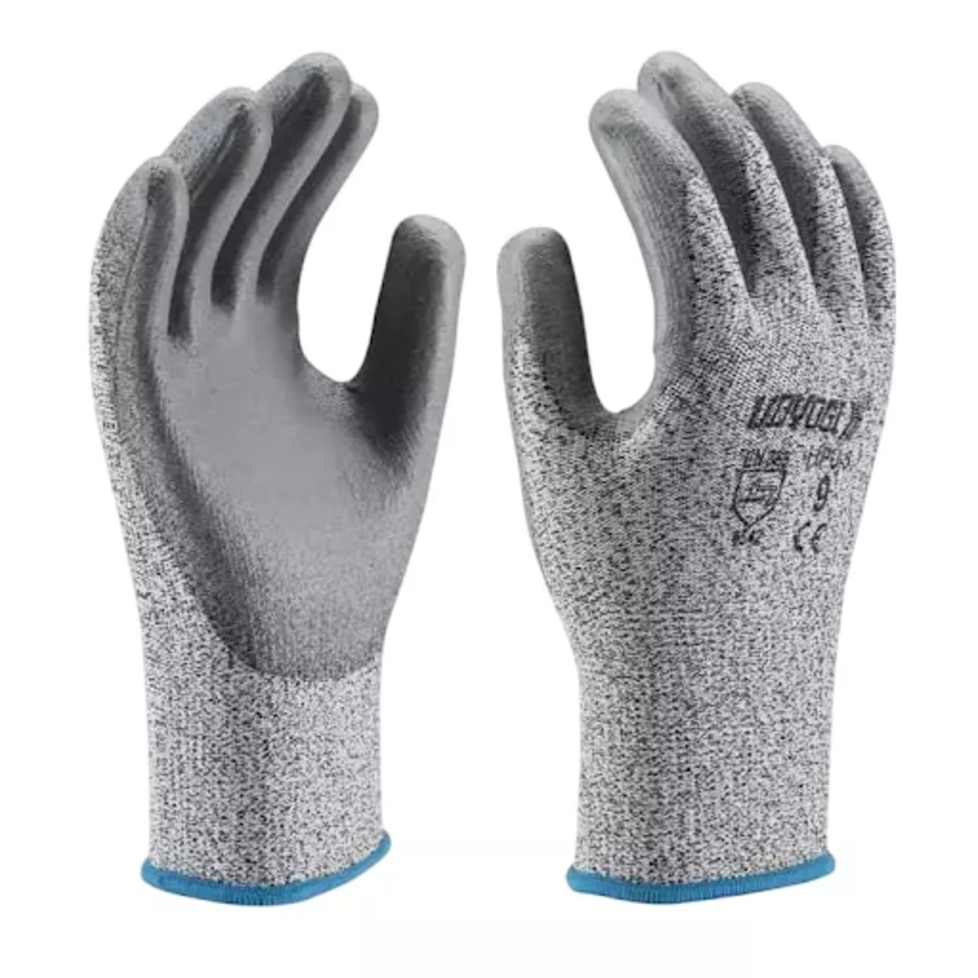
- On the EN 388 pictogram, check the five-position code: abrasion, Coup cut, tear, puncture and ISO 13997 cut. An optional P indicates impact protection.
- Confirm whether a claimed “Level 5” is the Coup result or the ISO 13997 result. The Coup blade can dull against highly cut-resistant materials, making ISO 13997 the more discriminating result.
- Look for the actual ISO 13997 letter, A through F, rather than accepting a generic cut claim.
- On an ANSI/ISEA 105 label, find the ANSI/ISEA 105 A1 through A9 classification. It reflects the gram load needed to cut through the material: A1 is 200–499 g, A4 is 1,500–2,199 g, A6 is 3,000–3,999 g and A9 is 6,000 g or more.
- Treat either rating as a laboratory classification for a new, correctly sized glove—not a guarantee of wear time against your blade.
Cut ratings do not cover puncture, tear, abrasion, impact, heat, chemicals or electricity. Check those properties separately, and inspect gloves before use; discard them after cut-through, tearing, severe abrasion, contamination beyond care instructions or loss of fit and grip.
Choose the construction, grip and fit that workers will use
Choose the lowest cut rating that controls the assessed hazard without making workers lose dexterity or remove the gloves. Test the actual size during cutting, assembly or handling: a loose glove can snag and shift, while an overly tight glove causes fatigue and leaves workers gripping harder.
| Material | Protection and trade-off | Best fit |
|---|---|---|
| HPPE gloves | Light, flexible and tactile, with strong cut performance; heat and open-flame tolerance are limited. | Repetitive knife work and assembly at ambient temperature. |
| Aramid gloves | Cut and abrasion resistance with better heat tolerance than HPPE; less tactile and vulnerable to degradation from some chemicals and ultraviolet exposure. | Hot parts, fabrication and handling where moderate dexterity remains essential. |
| Para-aramid | A heat-resistant aramid construction that handles intermittent contact with hot edges better than ordinary high-dexterity yarns. | Glass, metal or stamped parts that retain heat. |
| Stainless-steel yarn gloves | Steel reinforcement raises cut resistance and durability but adds weight, stiffness and snag points. | Severe edge exposure when precise finger movement is less important. |
| Glass-fibre yarn | Improves cut resistance in blended yarns, though broken fibres can irritate skin and washing can alter performance. | Blended designs where added protection outweighs maximum comfort. |
| Leather | Excellent abrasion, rough-material handling and grip; bulky, less tactile and not automatically cut resistant. | Burrs, castings and heavy handling, not fine knife control alone. |
| Coated designs | PU, nitrile or PVC coatings improve grip; choose nitrile for oily handling, but the coating does not create cut protection by itself. | Wet, oily or smooth materials when the underlying yarn supplies the cut resistance. |
Require a sizing trial with the intended coating, cuff and closure. If Shree Krishna Safety Products is supplying workplace footwear, keep glove selection tied to the hand hazard rather than treating a general PPE purchase as one specification. Inspect seams and exposed gaps before use.
Control residual exposure and replace gloves before protection fails
A cut-resistant glove cannot make an unguarded blade safe: it can snag on rotating equipment and pull a hand into an entanglement hazard. Install blade guards, use retractable or self-retracting knives, secure material in fixtures, and use mechanical handling before relying on gloves.
1. Isolate the machine before clearing jams, changing blades or reaching into a cutting zone. Do not wear gloves near rotating shafts, drills, lathes or other snag points unless the machine-specific assessment permits them.
2. Define every remaining hazard separately. Specify puncture resistance for pointed wire, splinters and burrs; needle-stick protection for discarded needles or similar points; and separate requirements for tear, abrasion, impact, heat, chemicals and electricity. A high cut rating does not cover these hazards.
3. Inspect each glove before use. Reject it for a cut-through, hole, torn seam, exposed fibre, excessive abrasion, hardened coating, contamination beyond cleaning instructions, loose fit or loss of grip. Stop work if the glove catches, slips or no longer lets you control the tool.
4. Follow the manufacturer’s washing, drying and reuse limits. Cleaning can alter dimensions, coating adhesion and protective performance, so do not extend service life by laundering beyond the stated limit.
5. Replace gloves after repeated handling when the palm or fingertips show thinning, glazing, embedded fragments or reduced grip, even without a visible hole. Keep replacement pairs available so workers do not continue with damaged protection.
Frequently asked questions
Which tasks expose hands to cuts?
Cut exposure occurs during knife work, deburring, sheet-metal fabrication, glass handling, recycling, assembly, warehouse handling and maintenance involving sharp edges, blades, wire or broken parts.
How do you choose the right cut-resistant glove?
Match the glove to the edge, force, material, grip needs, temperature, liquids and required dexterity. A higher rating alone does not guarantee the best glove for the task.
What do EN 388 and ANSI/ISEA 105 cut ratings mean?
EN 388 reports mechanical protection, including cut resistance, through a marked test result on the glove. ANSI/ISEA 105 uses cut levels based on measured force. Compare the exact rating with the task risk and test method.
When should cut-resistant gloves be replaced?
Replace gloves when the fabric is cut, thinning, torn, stretched, contaminated, losing grip or no longer fits securely. Gloves do not control exposure to moving blades or remove the need for safe handling procedures.