A high noise reading alone does not tell you which earmuff will protect a worker, because exposure duration, frequency, impact peaks, fit and other PPE all change the result. By the end, you will be able to measure the work area, decide between earplugs, earmuffs or dual protection, compare attenuation data, test the complete PPE combination and establish correct daily use.
Key takeaways
- Measure noise at the worker’s ear during the loudest tasks.
- Use dual protection when one device cannot reduce exposure sufficiently.
- Compare NRR, SNR and octave-band attenuation for the actual noise.
- Check earmuff seals after fitting hard hats, eyewear or face shields.
Measure the Exposure Before Choosing Hearing Protection
Measure noise at the worker’s ear, across the tasks and shifts that create the highest exposure. A sound level meter shows the level at a location or during a specific event; a noise dosimeter follows one worker through the shift and calculates the 8-hour time-weighted average noise exposure.
- Place the microphone in the worker’s hearing zone, not beside the machine. Record readings during normal production, maintenance, start-up and nearby impact operations.
- Use A-weighting for overall exposure and record dBA. Add octave-band measurements when the source contains low-frequency machinery noise or a strong tonal component, because A-weighting can understate those frequencies.
- Capture peak or impact levels separately. A brief impulse does not describe the worker’s full-shift dose, and a moderate average does not erase a damaging peak.
- Compare results with the applicable limit. Under OSHA’s general-industry rule, 85 dBA as an 8-hour TWA triggers hearing-conservation requirements at a 5-dB exchange rate; 90 dBA is the 8-hour permissible exposure limit.
| Instrument | What it tells you | Best use |
|---|---|---|
| Sound level meter | Level at one place and time | Mapping machines, tasks and octave bands |
| Noise dosimeter | Personal dose and 8-hour TWA | Mobile workers with changing tasks |
Use the measured level, exposure duration and frequency spectrum to choose attenuation. Do not select an earmuff from its highest advertised rating alone; a laboratory number cannot reveal whether the muff controls the worker’s actual source. Noise reduction also requires engineering and administrative controls, not PPE alone.
Decide When Earmuffs, Earplugs or Dual Protection Apply
An earmuff is the better choice when you need quick, repeatable protection, workers move between noisy and quiet areas, or earplugs cannot seal the ear canal reliably. It suits continuous machinery noise, especially when workers remove plugs to communicate or when dirty hands make insertion unsafe.
| Option | What it means | When it applies |
|---|---|---|
| Earmuffs versus earplugs | External cups seal around the ears; plugs seal the ear canal | Choose earmuffs for intermittent access, poor plug fit, or frequent removal |
| Earplugs | Compact protection that works with other headgear | Choose plugs under helmets, in heat, or where a good individual fit is confirmed |
| Dual hearing protection | Earplugs and earmuffs worn together | Use when exposure remains above 100 dBA as an 8-hour TWA after controls, or when extreme peaks demand added protection |
Do not add the NRR values together. OSHA’s dual-protection method adds 5 dB to the higher-rated protector before derating, so the increase is limited. For intermittent impact noise, inspect peak measurements rather than relying on one dBA average, and ask for test data or a stated suitability for impulsive noise.
A standard attenuation rating does not prove protection against every blast or impact. Even with dual protection, improve machinery controls and correct poor fit.
Read NRR, SNR and Octave-Band Attenuation Correctly
A label is a laboratory result, not the dB reduction a worker will receive. Compare the rating with the measured spectrum, then account for fit, eyewear, hair, head shape and wearing time.
| Rating | What it means | How to use it |
|---|---|---|
| Noise Reduction Rating NRR | U.S. laboratory rating in decibels | Apply the OSHA NRR calculation; do not subtract the label directly from workplace dBA |
| Single Number Rating SNR | European laboratory rating in decibels | Compare it only with measurements and products using the same SNR method |
| Octave-band attenuation | Reduction reported at frequencies such as 125, 250, 500, 1,000, 2,000, 4,000 and 8,000 Hz | Match low-frequency or tonal machinery noise to the bands where the earmuff performs well |
For A-weighted noise, use adjusted NRR = (labeled NRR − 7) ÷ 2, then estimate the protected level as workplace dBA − adjusted NRR. This OSHA NRR calculation is an estimate, not a guarantee; do not treat SNR and NRR as interchangeable numbers.
Octave-band attenuation exposes weaknesses hidden by one overall rating. A muff with a high headline value can leave low-frequency engine noise insufficiently controlled. Ask for the test report when the source is tonal, low-frequency or impulsive.
Fit testing measures worker-specific attenuation and reveals leakage from glasses, hair or inconsistent placement. For dual protection, add 5 dB to the higher-rated protector before applying the derating method; do not add earplug and earmuff ratings together. For impact noise, require data or stated suitability for impulsive exposure.
Select and Fit the Earmuff With the Full PPE Combination
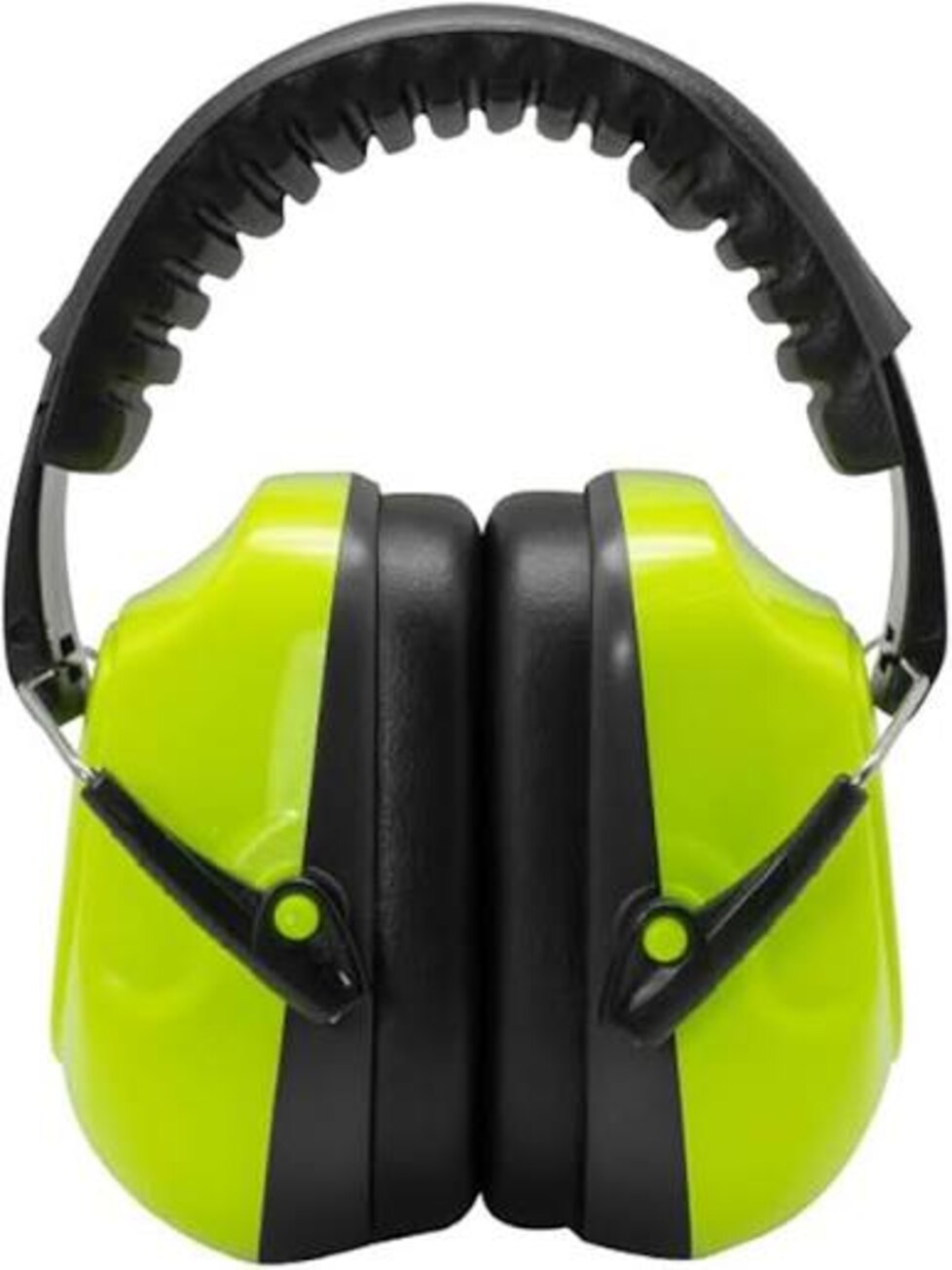
Choose the earmuff only after fitting it with the worker’s complete PPE: helmet, spectacles, face shield, hood and work clothing. A banded model suits workers who do not wear a helmet, while helmet-mounted earmuffs must match the helmet’s slot, carrier geometry and adjustment range.
Never improvise an attachment; it can break the earmuff cup seal and weaken the helmet’s protective function.
| Configuration | Approval check | Main failure risk |
|---|---|---|
| Banded earmuff | Headband sits evenly and cushions contact bare skin around both ears | Hair, spectacles or hood edges interrupt the seal |
| Helmet-mounted earmuffs | Carrier locks into the specified helmet slots and cups move through their full adjustment range | An incompatible carrier leaves gaps or damages helmet performance |
Check these points during a real work task, not only at the desk:
- Press each cup gently against the head and confirm continuous contact around the entire cushion.
- Set headband pressure high enough to seal, but not so high that heat or pain encourages removal.
- Look for hair, spectacle arms, helmet suspension parts, facial hair or hood fabric beneath the cushion.
- Ask the worker to turn, bend, wear the face shield and communicate; the cups must stay centred without lifting.
- Replace cushions that are cracked, flattened or sticky.
For procurement, verify the exact configuration’s conformity documents: EN 352-1 covers conventional earmuffs, while EN 352-3 covers helmet-mounted earmuffs. A trial arranged through Shree Krishna Safety Products should include the actual helmet and eyewear used on site, not a bare-ear demonstration.
Make Correct Use, Maintenance and Communication Routine
Workers keep earmuffs on when the protection is comfortable, compatible with other PPE, and built into the hearing conservation program rather than treated as optional equipment.
A supervisor should watch real tasks, correct lifted or poorly seated cups immediately, and provide a quiet area for conversations instead of encouraging workers to remove protection beside the machine.
- Before entering the noise area, inspect the cushions, headband, hinges, and seals. Replace cracked cushions, stretched bands, or damaged cups.
- Wipe cushions and surfaces with mild soap and water; do not use solvents that can harden or swell the sealing ring.
- Seat each cup fully over the ear, with hair, eyewear arms, helmet straps, and hood material kept out of the seal.
- Use agreed hand signals, visual indicators, or approved communication equipment. Test radios and alarms with the earmuff worn, not held in the hand.
- Run earmuff fit testing during training and after a significant fit problem, using a quantitative or qualitative method to identify workers who need adjustment, another model, or dual protection.
- For level-dependent earmuffs, check batteries, microphones, controls, and electronic function before each shift. Prevent users from disabling the limiter or raising audio above the approved setting.
- Store earmuffs away from heat, oil, sunlight, and crushing loads, and record cushion or battery replacements.
Review audiometric results, fit-test findings, and reports of missed alarms in the program. If communication remains unreliable, reduce the noise at its source or select a simpler passive earmuff instead of accepting unsafe removal.
Frequently asked questions
How do you measure workplace noise before selecting an earmuff?
Use a sound level meter for locations or events, and a noise dosimeter to track one worker’s 8-hour time-weighted average across a shift.
When should you use earmuffs, earplugs or dual hearing protection?
Choose based on exposure level, task demands, communication needs and fit. Use dual protection when a single device cannot provide enough reduction.
What do NRR, SNR and octave-band attenuation mean?
NRR and SNR are hearing-protection rating systems. Octave-band data shows how attenuation changes across low, middle and high frequency bands, helping you match protection to the noise.
How should an earmuff be selected with other PPE?
Confirm that the cushions seal around the ears after you put on the hard hat, safety glasses, face shield, respirator or other required PPE.
How do you keep earmuffs effective during routine use?
Wear them continuously in noisy areas, inspect cushions and headbands, clean them as directed, replace damaged parts and establish a clear communication method.