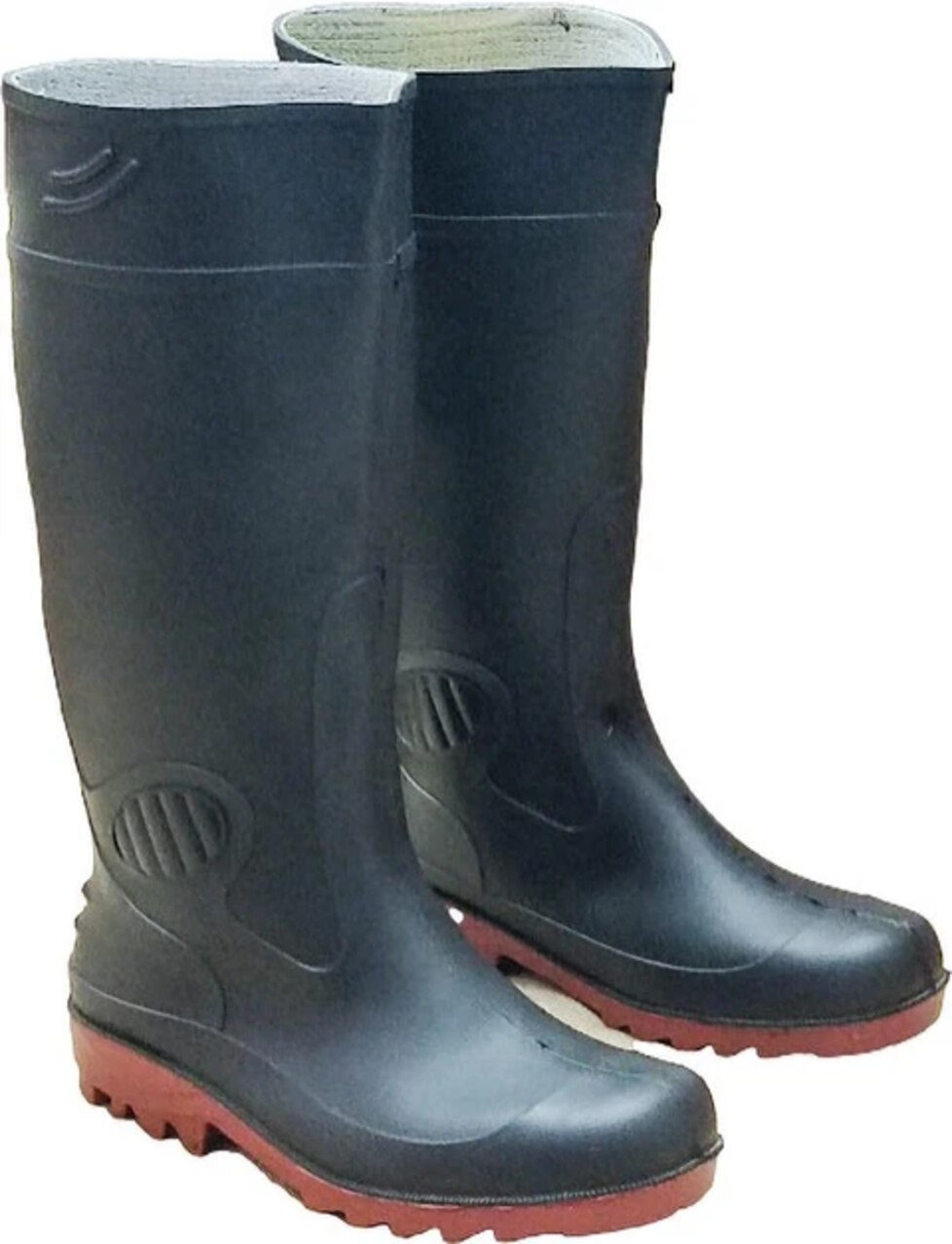
Mud or standing water alone does not decide whether you need safety gumboots. By assessing water exposure, impact and puncture hazards, traction, fit, hygiene, and task demands, you can choose footwear that protects workers without creating new risks.
Key takeaways
- Choose gumboots when water repeatedly enters or undermines ordinary safety shoes.
- Verify waterproof construction against the depth, duration, and type of exposure.
- Match toe, sole, puncture, and chemical protection to documented site hazards.
- Check fit, traction, and moisture control before and during each shift.
Start With the Site Hazard Assessment, Not the Puddle
Choose gumboots when a documented hazard assessment shows that water or mud will repeatedly enter or undermine ordinary safety shoes—not merely because one puddle is present. At a wet worksite, record the exposure before selecting footwear.
- Standing water: Measure its depth and duration. Water reaching the ankle opening will enter a low safety shoe quickly.
- Repeated puddles: Note how many crossings each shift force workers through water, and whether the route can be drained or rerouted.
- Mud depth for gumboots use: Record the deepest mud and whether workers must pull their feet free. Deep, sticky mud demands shaft height, grip, and secure footing.
- Washdown work: Include hose pressure, splash height, floor drainage, and time spent inside the wet area.
- Outdoor time: Count hours exposed to rain, wet grass, poor drainage, and changing ground conditions.
Then assess hazards beyond moisture. Falling or rolling objects, sole penetration, and electrical hazards require footwear selected for those risks under OSHA 29 CFR 1910.136; waterproof construction alone does not provide that protection. ASTM F2413 protective-toe compliance also does not prove waterproofing or slip resistance.
Use ordinary safety shoes when water exposure is brief, stays below the upper, and the route drains between crossings. Choose gumboots when standing water, repeated puddles, washdown, or mud consistently reaches the shoe’s entry points or leaves workers standing in moisture.
Check the complete safety classification, such as EN ISO 20345:2021 S6 or S7, rather than trusting the word “waterproof” alone.
Check Whether the Boot Is Waterproof for the Exposure You Have
A waterproof claim is meaningful only when the entire footwear resists water entry. Water-resistant safety shoes may protect the upper material while water enters through the ankle opening, tongue, seams, or lace area.
- Look for the EN ISO 20345:2021 classification and the WR marking, not only the word “waterproof.” S6 combines S2 protection with whole-footwear water resistance; S7 combines S3 protection with whole-footwear water resistance.
- Check the construction. A molded waterproof gumboot has fewer stitched entry points than a shoe with a separate tongue, eyelets, and sewn seams.
- Match the test to the exposure. WPA covers water penetration and absorption of the upper; it does not prove that the complete footwear will withstand standing water, repeated washdown, or prolonged immersion.
- Treat an unexplained waterproof claim as incomplete. Ask for the standard, classification, and test marking.
- Separate safety-toe evidence from water evidence. ASTM F2413 confirms protective-toe performance and selected optional protections, but it does not by itself establish waterproofing or slip resistance.
| Footwear information | What it proves | Decision |
|---|---|---|
| Whole-footwear WR | The assembled footwear passed a water-resistance test | Consider for persistent wet exposure |
| Upper-only WPA | The upper material resisted penetration and absorption | Suits brief wet contact, not standing water |
| “Waterproof” without a standard | No test scope is identified | Request documentation before purchase |
Match Protection Features to Mud, Impact, Puncture, and Chemicals
A waterproof upper does not protect against a falling load, a nail, or a chemical splash. Compare the boot’s protection markings and construction against each hazard before choosing by appearance.
| Feature | What to compare | What it protects against |
|---|---|---|
| Toe cap material | Steel, aluminium, or composite cap; verify the applicable impact and compression marking | Falling or rolling objects. ASTM F2413 confirms protective-toe performance, not waterproofing or grip. |
| Puncture-resistant midsole | A separate puncture-resistance marking or test result | Nails, scrap, and sharp objects underfoot. Deep lugs do not prove puncture protection. |
| Outsole tread | Lug shape, spacing, heel geometry, and resistance to clogging with clay | Mud evacuation and traction. Heavy tread alone does not establish slip resistance. |
| Slip resistance on mud and concrete | Test evidence covering wet, contaminated, or smooth surfaces | Falls on both outdoor mud and indoor concrete. Puncture resistance solves a different problem. |
| Chemical compatibility | Boot material matched to the chemical’s safety data sheet, concentration, temperature, and contact time | Swelling, hardening, cracking, or loss of protection after exposure. |
For European footwear, check the complete EN ISO 20345:2021 classification: S6 combines S2 with whole-footwear water resistance, while S7 combines S3 with that protection. Do not treat antistatic footwear as electrical insulation; electrical-hazard footwear is secondary protection and wet contamination can reduce its effectiveness.
When comparing options with Shree Krishna Safety Products, give the manufacturer your hazard list and request separate evidence for toe, puncture, traction, chemical, and electrical claims rather than accepting “industrial safety” as one blanket rating.
Test the Fit and Control Moisture During the Shift
Try boots on after your feet have swollen, using the thick socks and insoles worn at work. Check for toe clearance while walking downhill or down steps: your toes must not strike the front. The heel should stay seated without excessive heel lift, and the shaft should hold the leg without squeezing the calf.
Walk, bend, and squat before accepting the fit; a loose, heavy boot increases fatigue and changes your stride.
Standing in waterproof boots still traps sweat and condensation. Prolonged dampness causes sweat and skin maceration, blisters, and painful rubbing, so treat moisture control as part of the shift plan.
- Wear moisture-managing socks and change them when they become damp. Carry a dry spare pair in a sealed bag.
- Remove boots during safe breaks to ventilate your feet. Rotate between two dry pairs when the work schedule allows.
- Rinse mud and contaminants from the boot after work, then brush the sole and inspect the tread, upper, seams, and toe area for damage.
- Remove the insole, open the boot fully, and dry it at room temperature with moving air. Do not place rubber or polymer boots against a heater or intense sunlight; heat can cause cracking, distortion, or adhesive failure.
- Check the fit and condition before the next shift. Replace boots when the heel slips, the lining stays wet, cracks expose the upper, or the sole loses secure contact.
Know When Gumboots Create More Problems Than They Solve
A wet surface does not automatically justify a heavy waterproof boot. Gumboots on ladders can reduce ankle movement, catch on rungs, and make foot placement less precise. They are also a poor choice for long shifts on dry concrete, where weight and stiff shafts increase fatigue without solving a water problem.
| Condition | Better choice | Why |
|---|---|---|
| Dry concrete walking | Safety shoe with cushioning and grip | A lighter shoe reduces fatigue and preserves normal walking mechanics. |
| Ladder work | Secure, flexible safety shoe | A stiff or oversized gumboot can hinder rung contact and balance. |
| High-heat work areas | Safety shoe with breathable footwear materials | Waterproof construction traps heat and sweat, increasing discomfort and moisture inside the boot. |
| Electrical exposure | Footwear with a verified electrical rating | Ordinary waterproof rubber does not prove electrical protection; check the marked rating and standard. |
| Chemical splash or hot liquid | Chemical- or heat-rated footwear | Waterproofing alone does not show resistance to the substance or temperature involved. |
Do not select a gumboot for electrical work because it is made from rubber. Verify the electrical rating for the identified voltage hazard, and replace the boot if cuts, contamination, or wear compromise its protective properties.
Cold outdoor work also needs a separate check. Waterproof construction does not establish cold insulation; look for the CI designation where EN ISO 20345 applies, then confirm that the fit leaves room for work socks without compressing them. Choose breathable footwear when water entry is not the dominant hazard.
Frequently asked questions
When should workers choose safety gumboots for a wet or muddy worksite?
Choose them when a documented hazard assessment shows that water or mud will repeatedly enter or undermine ordinary safety shoes.
How do you check whether a safety gumboot is waterproof enough?
Compare the boot’s waterproof construction with the exposure’s depth, duration, entry points, and contact with standing water or mud.
Which protection features matter on muddy worksites?
Match toe protection, slip-resistant soles, puncture resistance, and chemical resistance to the impact, traction, sharp-object, and substance hazards recorded in the assessment.
When can safety gumboots create problems?
They create problems when poor fit, trapped moisture, limited movement, inadequate traction, or unsuitable protection increases risk during the shift.